
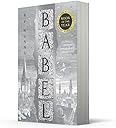


Babel
Desertcart purchases this item on your behalf and handles shipping, customs, and support to Cook Islands.
Description
Oxford, 1836. The city of dreaming spires. It is the centre of all knowledge and progress in the world. And at its centre is Babel, the Royal Institute of Translation. The tower from which all the power of the Empire flows. Orphaned in Canton and brought to England by a mysterious guardian, Babel seemed like paradise to Robin Swift. Until it became a prison… But can a student stand against an empire?
Specifications
| Dimensions | 5.08 x 1.38 x 7.8 inches |
| Isbn 10 | 0008501858 |
| Isbn 13 | 978-0008501853 |
| Item Weight | 2.31 pounds |
| Language | English |
| Print Length | 546 pages |
| Publication Date | August 17, 2023 |
| Publisher | HARPER COLLINS |
Reviews
User
There are no words...
I found this book several years ago through a social media post recommending “five-star reads” and it could not have been more right. I remained interested, and even though it took a while to get into my hands and mind, it was well worth the read. The author is a brilliant writer, full of wisdom and wit. What surprised me most about this book was how quickly it hooked me. Was it a fast read? Absolutely not. Babel was a slow and brutal burn that took way longer than I thought it would. Not because it was uninteresting, but because it was fascinating. I found myself looking up so many words, from vocabulary definitions to synonyms to overall new ways to say a word in a different language. I learned so many new things from this book and enjoyed how quickly I related to the characters. I loved taking the journey with Robin from Canton to Babel, growing with him from a boy, and discovering a world bigger than he was prepared for. It was like I was growing up all over again, picking up new pieces to a puzzle I have long since given up on. Some of my favorite scenes involved heavy dialogue, unknown words, and plenty of banter. I am so glad this book took its time because its impact grew with every page. The theme of this book centers around racism, colonizing, and the control of people. Some parts were challenging, and my heart hurt, but it is good to remind ourselves that we are strong and persistent, even within the words of a book. Especially words that can be pulled out into lived lives and be so heavy on our reality. If this book were turned into a movie or series, it would have to be handled delicately so as to preserve the message of the author and Robin Swift. I would recommend this book to anyone who is “not like” everyone else, those who take pride in their differences, while respecting their similarities with others. To individuals that stand tall, know who they are, but know fairness, equality, and patience. Readers who know that justice comes with a price but will not shy away from what they believe. The magic of language and all it stands for, the world building with Oxford and translators, the fantastical dive into academia and friendship, the thrill of powering the world and those who oppose it, the emotional rollercoaster with the Babblers quartet, the knowledge shared from Kuang through scholars, the tower of information and the place in which it stands; all of this looks to separate those willing to lead and make a difference, from those who want to remain on the sidelines, and follow. This book will take its toll on you, which will make you think your way in circles as you question things you’ve seen, heard, and learned. I can’t say what I think clearly, but pick up this story, read it. Reading this book is unlike anything I have experienced and will stay with me long after. I cried (boy, did I cry), I laughed, and I raged. I loved every minute of it, I wish I was still reading it and have no idea what I will do now.
User
Intriguing
I gave it four stars but it would be 4.5 if that were an option. I love books that make me think about possibilities and also teach me some history. This writer is brilliant and is clearly bursting with imagination surrounding their academic pursuits. Part of me wanted it to be two books: one about the four friends and the evil colonists, and another about etymology and fantasy. But it was intriguing and mostly worked. The writing is excellent. The history is thought provoking. The end dragged a little. I recommend this to anyone who likes historical fiction and contemplations about the trappings of higher education and the institutions it builds.
User
Amazing read! 10/10 story and amazing symbolism
This is the first book in a while that's left me truly speechless. It starts off sad, and slowly builds until Chekhov's gun fires and the tower comes crumbling down.There are so many things I could say about this book, I'm not really sure where to begin, so I guess I'll start at the beginning. At the start of the book, Babel is shown as a wonderful and amazing creation that benefits all. However even then you see the mask begin to slip, the hints of cruelty and indifference. As the story continues, the mask slips more and more until you're staring into the mass of harm and rot Babel had become, still keeping up its smile even with the newly visible blood dripping from its wealth.Speaking of slow changes in perspective, Robin was an amazing choice as the main character! He starts off falling into the appeal of Babel and what it offers, buying into its disguise as he's gifted the riches stolen from foreign lands without understanding the pain that got it there. There's even a scene in the book early on where Robin sees a homeless family and tosses literal pennies from his limitless budget at them, which was a perfect metaphor for how Babel as a whole acted. Tossing pennies at the poor people while patting itself on the back and ignoring the actual horrors of what's happening. As the story goes on though, he starts seeing the cracks in the walls and the gaps in the mask. Watching his character's descent from a peaceful but cowardly kid into the determined martyr that was willing to tear down an empire with its own creation was somehow both extremely satisfying and extremely haunting.The commentary on violence was also incredibly thought out and explained. One thing this book did particularly well was showing arguments for both sides. Neither the violent nor the peaceful side were dumbed down to make the message easier, but the effects and results of the actions still made an extremely convincing argument. Another thing I loved about this book was the realism when showing the ways the characters affected the world. It showed clearly that revolutions weren't just everyone vs the government, the fighting isn't glamorous or fair, and the people's reactions and ideas were always reasonable for their character.Babel as a whole also makes an amazing metaphor. It shows you the side you'd see if you lived there at the time, all the luxury and none of the violence. The people weren't shown the silver mines, or the opium dens, or the fields of plants entire cities were leveled to grow. It really made me process for the first time why it took so long for significant movements against colonialism to form. This book also did an amazing job of showing that some people will stare directly at the belly of the beast and still choose to look away since that's easier than confronting what they'd ignored for years.All of that coming to an end as Babel, doomed to one day fall beneath its own claws, was crushed by the very thing it claimed to idealize and fought to protect. The languages and silver stolen from faraway lands became the very things that brought about Babel's downfall.
User
Not Sure
Disclaimer: a book cannot be reviewed like a vacuum cleaner or a dress. Any book that has emerged from the traditional publishing system has been subjected to the most rigorous review process and vetted by the most reputable experts before it’s released. Unlike other product reviews star ratings for a novel only indicates the personal reactions of this particular reader whose tastes, experiences, and upbringing are unique to her and may differ considerably from other readers’ reactions. my review should not form the ultimate basis on whether or not to purchase and read this book. Reading is always a gain, even when the book may not be to our liking. So do read the book and see later where your opinion differs or meets mine.What I liked: the premise. It is a brilliant, and a lyrical metaphor to use translation as the foundation for this imagined world’s industrial progress. As a literary translator, I appreciated the many reminders of the uniqueness of each language and the challenge of translating from one to another when there is never an exact correspondence of terms. I loved that the difference in connotation between word pairs from different languages created the magic, the possibility for manifestation. Translation throughout the book serves as a synecdoche for the infinite potential inherent in harmonious diversity even if in the book that harmony (spoiler alert) is never realized. I loved some of the final passages equating translation to the ability to listen and the willingness to understand. Lovely, hopeful, and in my experience at least, true.I also enjoyed reading about the many etymological roots and corresponding anecdotes. For lovers of language there are many gems embedded in this book. This is a truly imaginative world and in most ways, well-conceived.What I didn’t like: the book is often repetitive and sometimes too didactic about translation theory, even if informative. in parts it felt more like a language history lesson then a novel and made the story slower and much longer than it needed to be. The book also was heavy handed with its preachy morality, and often contradictory with its indictments.The author seemed more interested in polemics than in telling a story. All the characters felt flat but all the more so the villains who are all irredeemable monsters. Of course all the villains are white and all of them single-mindedly motivated by greed and by their certainty in their racial superiority. They each launch into long monologues to justify their actions and motivation but every argument offered sounds flat, shallow, as if excerpted from the same simplistic textbook definition of racism. One character, Letty, is especially inscrutable in her motivations though the author goes to great lengths to explain (not show) her mindset. In the end even the author seems to give up and assigns her the same generic and simplistic reasoning that all the other one-dimensional villains offer and, when it comes to the most unjustified and bewildering betrayal she has the character admit that she doesn’t know why she did it (that is, not even the author knows why except that the story needed a white girl to be a villain so there she was.)Of course colonialism was a scourge that destroyed countless lives and whose destructive effects are still felt today in many parts of the world. Of course racist systems are cruel and seriously hamper progress (but can we be honest about racist systems existing and thriving in Asian countries, too?) I am not arguing with the evil of colonialism or the cruelty of racism. I’m merely saying that the story and characters are manipulated to show only the most superficial and sophomoric conclusions about it. It offers no new insights as it is only interested in proving what it already takes as a foregone conclusion.From an author who is capable of such brilliant imagination and lyricism, the story is awfully shortsighted on human nature, including when it comes to its protagonists and heroes (who are all sinless, blameless, and morally perfect but who reveal nothing of their inner lives except what is obvious.) As a result the plot is predictable. in many instances, reveals that are shocking to the protagonists are obvious many chapters before the protagonist finally catches on (for instance, Anthony’s involvement with Hermes.) Therefore the story’s pacing is slow and attention shifts to the preachy didactics of racial politics.Even so, the enormity of the scope of this work deserves credit and there is plenty to love about this book to make it worth the time to read. in the least it stimulates much needed conversations and thought about the thorny subject of race. I give it a three star only because I expect a literary author to transcend the superficial and often delusional petulance of mainstream rhetoric for something deeper and more accurate, and the insistence on simplistic conflations distracted me. But the book deserves to be read.
User
Well Worth The Hype
"Babel: Or the Necessity of Violence: An Arcane History of the Oxford Translators' Revolution" is a remarkable literary work that delves deep into various facets of translation, colonialism, and their real-world implications. I saw this recommend on TikTok so many times and was going to ignore it because TikTok recommendations are a very specific brand of content that I don't usually enjoy, but the recommendation for this one was so remarkable that I felt I had to see for myself. One of the standout features of this book is its insightful commentary on colonialism. The parallels between translation and colonialism are clear and obvious, without being condescending. I found it to be a beautiful and thoughtful workup that really encourages the reader to explore what it means to exist in the systems we've created. Even though the book is obviously fictional, the principles are real and current. Through well-researched examples and analysis, the book sheds light on the complex relationship between language, culture, and colonialism, making it an invaluable resource for understanding this historical context. Beyond being a historical account, "Babel" demonstrates the real-world applicability of its themes. It draws parallels between past colonial practices and contemporary issues, emphasizing how the legacy of colonialism continues to influence our global society, which isn't a new idea for some people but needs frequent reminding I think. The book's narrative is infused with a sense of tragedy, as it explores the injustices and suffering caused by colonialism and this emotional depth made personal through the unique and nuanced characters of the story adds a powerful layer to the storytelling, making it a thought-provoking and emotionally resonant read. I cried a lot but mostly felt a consistent heartache throughout that literally never got better. The whole story is so tragic and yet so understandable- so realistic- which makes it all the more devastating. I felt incredibly resigned throughout the whole book. The author's incredible talent for foreshadowing and painting parallels gives you a very clear idea of where the book is going from the beginning and even so, like any incredible writer, you are still devastated when you get there. I couldn't help but invest myself in hope, even knowing where things would end. "Babel" also impresses with its meticulous research and intellectual rigor. The author's depth of knowledge and scholarly approach shine through in every chapter. The book is not only informative but also intellectually stimulating, inviting readers to engage deeply with its content. I enjoy all the context for actual translations.To summarize, "Babel: Or the Necessity of Violence: An Arcane History of the Oxford Translators' Revolution" is a masterful exploration of translation, colonialism, and their lasting impact on our world. Its excellent commentary, real-world relevance, tragic undertones, and scholarly depth make it a must-read for anyone interested in the intersection of language, power, and history.
User
The Seamy Side of the British Empire
“That’s all speaking is. Listening to the other and trying to see past your own biases to glimpse what they’re trying to say. Showing yourself to the world, and hoping someone else understands.” (p535)There are two compelling, complementary stories in this thought-provoking novel. The tight shot is about divided loyalties and the search for a life of meaning; it includes powerful reflections on academia, elitism, misogyny, racism, power, and privilege. Zoom out for the broader context: a fictional account of the shameful, seamy side of the British Empire and Industrial Revolution, in which magical silver bars serve as a metaphor for a world dominated by exploitation, greed, colonialism, slavery, oppression, moral blindness, and the quest for hegemony. Connecting the micro and macro-stories is a fascinating exploration of language, linguistics, and culture. These three layers – divided loyalties, exploitation, and linguistics – combine to deliver an immensely satisfying reading experience.It’s only fair to report some minor disappointments. The plot hinges on several pivotal decisions, actions, and events that feel implausible, even in the fictional, magical world the characters inhabit. The finale leaves more unanswered questions than I would have liked. And there’s very little humor in the book – a shame, given that the author can be very funny (see her “Katabasis”). But these are quibbles; this excellent book is another winner from the talented R.F. Kuang.
User
Language is Power
Babel: an Arcane History, by R.F. Kuang(SPOILER ALERT)I have not always enjoyed alternative histories as a genre, but I do trust that books that win, or are even nominated for, the Nebula Awards are well worth reading.As a lover of languages, I was immediately drawn in to this book. In this alternate world, translation is a power. Bars of silver can be inscribed with a pair of words where the translated word fails to capture the essence of the original. Silver bars inscribed with those words, when their word-pair is read by someone fully fluent in both languages, cause the missing concepts to be manifested in the world. Silver bars are thus hoarded by England, and at Oxford University in the 1830s, the Translators are the super power that makes the British Empire’s ships faster, their medicines more effective, their carts safer, their sewers cleaner, their food more nutritious.But to continue to expand their powers, they need to bring in more languages. Robin, is rescued from a plague in China that has killed his family, by a professor in the Translation Tower. He is raised in the professor’s home, tutored in Greek, Latin, and English, while continuing to practice his Cantonese. This prepares him to be accepted at Oxford, where he quickly befriends other foreign students who are in similar situations. Ramy, from India, Victoire, from Haiti, and Letty, a British girl who rooms with Victoire. The severe discrimination that they face as foreigners and as women in 1830s Oxford is overcome by their sheer love of languages and the bonds they build with one another.Until they are sent on a mission to China, with Robin assigned to translate for a diplomatic mission, assigned to force China to accept their shipments of opium or to be attacked by the overwhelming might of the silver-powered British fleet.Suddenly the four realize that they are pawns in an Empire built on the backs of their motherlands. And that they must do something about it. But how do a handful of foreigners challenge the might of the Empire?—————-Kuang is uniquely qualified to write this amazing novel. She has an MPhil in Chinese Studies from Cambridge and an MSc in Contemporary Chinese Studies from Oxford; she is now pursuing a PhD in East Asian Languages and Literatures at Yale.Beyond the knowledge of languages though, she has done the work to deeply understand the history of Oxford and to be able to accurately portray the culture and the other-worldly richness of the academic crown jewel. She actually begins the novel by citing the many sources that she studied in order to make sure she captured the majesty of Oxford, including the most authoritative histories of today, but also many 19th century sources.Late in the book, I began imaging the tale as a parable about the computer age, as the Information Technology revolution became a tale of the haves and have-nots. I cannot say whether Kuang had that in mind or not, but it certainly worked on that level for me!Five stars. Especially for any students of history or linguistics!————There is one note of controversy. The Hugo Awards seem once more to have been “gamed.” Babel earned enough votes by the committee to be on the finalist list for Best Novel. The voting, however, is conducted at the World Science Fiction convention, which was hosted in China that year. Next to the novel’s name on the ballot were the words “not eligible.” No one has gotten to the bottom of that controversy, but it seems likely that the host government felt the book portrayed China in an unflattering way. The author expressed disappointment, but said she won’t dig into it further as “she has books to write.”
User
Smart, knowledgable, provocative "fiction" that searches for the moral compass
A smart and provocative book of "fiction". Certainly causes one to ponder. I wouldn't suggest it to anyone that prefers their global history whitewashed. The book shows a small crew of teenagers finding their moral compass amidst finding what they thought to be truths about the world at large did not encompass the whole picture. As time went on that whole picture became clearer causing them to question right from wrong. The book builds tension as it goes. The book is aptly titled: Babel:Or the Necessity of Violence. I did find myself comparing the "silver bars" to the ever-growing omnipresence of data centers and coding. With that said, there is little to no mention made of computers, data centers or computer coding in the story. There was interesting commentary on the origin of words throughout the world and why there is not a singular pure global language. And there is violence. The book is a little over 500 pages - it was a fast read (when not pondering) from the first page to the last.
User
رايي
متحمس له وصلني في حالة ممتازة بس باقي ما بديت اقراه
User
Original and compelling
It’s not an easy task to review a book that is such a monolith of ideas. I loved the whole vision and the narrative voice - a genuinely vivid and energetic mind telling a truly compelling story. The various references to Dickens are a clear indication of the writers love of great imaginative storytelling and the book is exactly that. A very intelligent book that deserves reading for its uncompromising attack on the British Empire and its rewriting of history through the eyes of four young men and women trapped in its system of double standards and hypocrisy. Vast in its vision and genuinely moving in the choices its characters make. Occasionally such truths are slightly tarnished by echoes of fashionable politically correctness while the strength of the book’s ideas and characters in themselves establish an unquestionable critique and system of values that does the job far more effectively than any dogmatic adherence to cancel culture or the like. A real standout book that despite being labeled as a YA novel involves a widely-read adult reader such as myself. Very much recommended.
User
livre
très bien - pas de problème
User
Great novel, terrible quality of the edition
I won't comment on the novel per se, because literarily it's great, but I'm INCREDIBLY DISAPPOINTED with the quality of the edition. I bought the novel in hardcover, hoping for the durability and solidity of the edition. Unfortunately, I found that despite the hardcover, the spine of the book is glued, not sewn, and the pages (every single one of them!) begin to fall off the spine after one flip. I fear that by the time I get to the end of the novel, they will have fallen off completely.I ordered the English-language edition specifically because of the hardcover, as in my country it only comes out in an integral binding. This turned out to be a big mistake, as the quality of the Polish edition is nevertheless much better.(Rating for novel itself - 5/5)
User
Overall good
A bit dusty other wise it was in perfect condition
Common Questions
Trustpilot