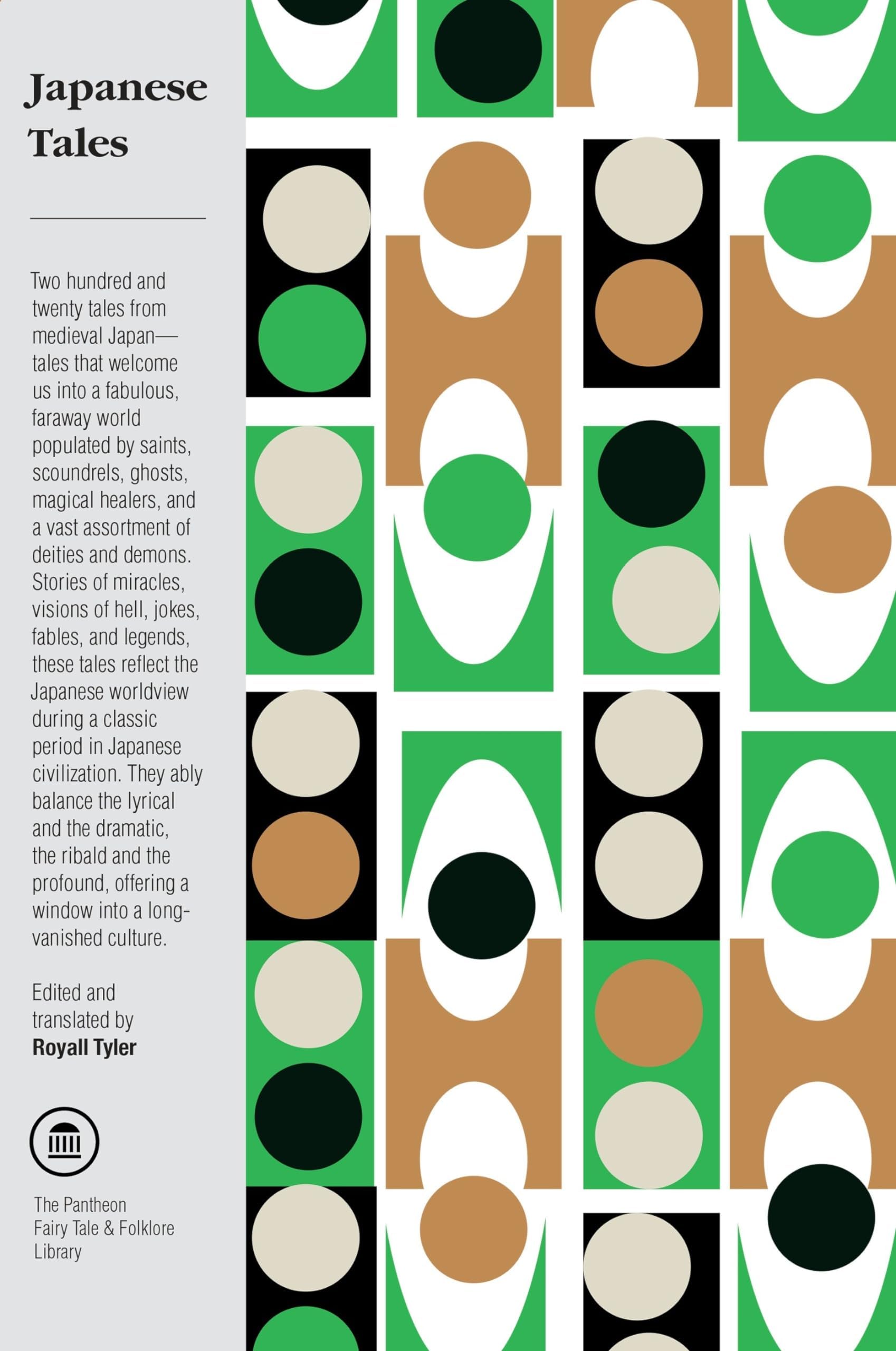
Japanese Tales (The Pantheon Fairy Tale and Folklore Library)
Product ID: 4095758
Buy anything from 5,000+ international stores. One checkout price. No surprise fees. Join 2M+ shoppers on Desertcart.
Desertcart purchases this item on your behalf and handles shipping, customs, and support to Cook Islands.
Two hundred and twenty tales from medieval Japan—tales that welcome us into a fabulous faraway world populated by saints, scoundrels, ghosts, magical healers, and a vast assortment of deities and demons. Stories of miracles, visions of hell, jokes, fables, and legends, these tales reflect the Japanese civilization. They ably balance the lyrical and the dramatic, the ribald and the profound, offering a window into a long-vanished culture. With black-and-white illustrations throughout Part of the Pantheon Fairy Tale and Folklore Library Review: Wonderful stories, excellent translation - "Japanese Tales" boasts an incredibly rich assortment of old Japanese stories, most either from or about the Heian period, an early classical golden age of Japanese culture and literature. The stories themselves evoke a great number of moods, and cover topics that run the gamut from vulgar (even the Japanese aristocrats of a thousand years ago enjoyed fart jokes) to austere. Most interesting is the incredible juxtaposition and intertwining of the spirit world with the "real" world. Asking the people of this classical age whether they believed in demons, fox spirits, bodhisattva, and the like would be about as ridiculous as asking people of the modern age whether they believed in puppies and bunnies. It's not a question of belief--these creatures and deities simply "exist". The translations are excellent, and it is an incredible credit to Royall Tyler that these stories--set in a time a millennium removed and half a world away from the reader--are so accessible and easy to read. Tyler effectively groups the stories by topic, giving the reader a bit of structure to the wonderfully diverse range of tales. The introduction is packed full of information, but perhaps my only (small) complaint is that with the large number of place names mentioned it would have been nice if a map had been included. Overall though, this collection of tales is an excellent addition to the canon of English translations of ancient Japanese literature and provides great insight to the mind and world of Heian Japan. "Japanese Tales" should be a must-read for all people interested in the folklore and literature of Japan. Review: a treasure bag of wonderful japanese tales - For my money, everything that Royall Tyler touches turns to gold, and that is as true of "Japanese Tales" as it is of his more recent translation of "The Tale of Genji." In "Japanese Tales," he has assembled and artfully translated 220 stories published between the ninth and fourteenth centuries in Japan, stories that are often difficult if not impossible to find elsewhere in English. For the most part, these are not the extended stories that we tend to call fairy tales in the West, and the book is not designed to provide reading material for children. What it does provide is a very solid sampling of the types of tales the early Japanese used to provide moral guidance, explain how things came to be, and record historical moments. And if that were not enough, Tyler's outstanding introduction, 35 pages in length, provides a lucid understanding of life in Heian-period Japan and beliefs about everything from serpents and mountains to deities and demons. This is simply a book you cannot afford to miss if your interests in Japan are those of either an enthusiastic amateur or a focused scholar.

| Best Sellers Rank | #674,916 in Books ( See Top 100 in Books ) #1,500 in Folklore & Mythology Studies #2,927 in Short Stories Anthologies #4,871 in Folklore (Books) |
| Customer Reviews | 4.6 out of 5 stars 244 Reviews |
C**S
Wonderful stories, excellent translation
"Japanese Tales" boasts an incredibly rich assortment of old Japanese stories, most either from or about the Heian period, an early classical golden age of Japanese culture and literature. The stories themselves evoke a great number of moods, and cover topics that run the gamut from vulgar (even the Japanese aristocrats of a thousand years ago enjoyed fart jokes) to austere. Most interesting is the incredible juxtaposition and intertwining of the spirit world with the "real" world. Asking the people of this classical age whether they believed in demons, fox spirits, bodhisattva, and the like would be about as ridiculous as asking people of the modern age whether they believed in puppies and bunnies. It's not a question of belief--these creatures and deities simply "exist". The translations are excellent, and it is an incredible credit to Royall Tyler that these stories--set in a time a millennium removed and half a world away from the reader--are so accessible and easy to read. Tyler effectively groups the stories by topic, giving the reader a bit of structure to the wonderfully diverse range of tales. The introduction is packed full of information, but perhaps my only (small) complaint is that with the large number of place names mentioned it would have been nice if a map had been included. Overall though, this collection of tales is an excellent addition to the canon of English translations of ancient Japanese literature and provides great insight to the mind and world of Heian Japan. "Japanese Tales" should be a must-read for all people interested in the folklore and literature of Japan.
M**D
a treasure bag of wonderful japanese tales
For my money, everything that Royall Tyler touches turns to gold, and that is as true of "Japanese Tales" as it is of his more recent translation of "The Tale of Genji." In "Japanese Tales," he has assembled and artfully translated 220 stories published between the ninth and fourteenth centuries in Japan, stories that are often difficult if not impossible to find elsewhere in English. For the most part, these are not the extended stories that we tend to call fairy tales in the West, and the book is not designed to provide reading material for children. What it does provide is a very solid sampling of the types of tales the early Japanese used to provide moral guidance, explain how things came to be, and record historical moments. And if that were not enough, Tyler's outstanding introduction, 35 pages in length, provides a lucid understanding of life in Heian-period Japan and beliefs about everything from serpents and mountains to deities and demons. This is simply a book you cannot afford to miss if your interests in Japan are those of either an enthusiastic amateur or a focused scholar.
M**G
The best introduction to any book I've ever read.
I bought this book for the sake of reading folk tales from another part of the world, but what I became enthralled with is the introduction. The author of this book delivers a master class in pre-feudal Japanese history, and how it differes from feudal Japan, while ensuring he also explains why stories were selected, and the relevance both to a modern reader as well as those these stories originated with. I learned a great deal of information, and that introduction has made the stories much more enjoyable. They are not your happy-sappy Disney fairy tales at all, but a wonderful insight into a different culture, if you are not Japanese.
C**E
Lots of diversity!
Great book! Some of the stories are a little short and very awkward, but that's sort of the nature of folk tales I suppose. Good selections and really quite enjoyable and informative on the whole. If you've read other books on Japanese mythology, you will hear some familiar ones here. Lots of diversity though!
L**D
A "Japanese 1001 Nights"
This book is a wonderful treasury of short tales from the Heian and Kamakura periods (Circa 1100-1300 CE) that will be of interest to anyone with an interest in Japanese literature. The stories that Royall Tyler has selected for this collection are often weird and gross but wonderful in their own way and often very funny as well. I have a difficult time imagining anyone turning to page 14 of this book and reading "The Tapeworm's Sad End" and not wanting to read the rest. This is a volume worthy of a place on the bookshelf next to that better-known collection of tales from the east, The 1001 Nights.
K**E
A good mix, but not much on the Shinto Gods or the creation story
This has been a wonderful read. I have used this in my Japanese club to read at our events. I have used this for history and background for learning about the culture/myths. It contains mostly Buddhist stories however and almost nothing in relation to the Shinto Gods, however Shinto is in here too. It does feature some fox stories and some ghost stories. It really is a nice mix, but you really don't learn about the main Shinto Gods here and the creation story is not included.
T**O
250 Short Medieval Stories from Japan
There are 250 short medieval stories from Japan in this book. The book is only 333 pages long, so it is easy to see that most of the stories in the book are only a page or two long each. The stories are nicely divided into 42 sections regarding different subject mater, for example: Surprises, Haunts, Magic, Ascetics, Desire, etc. I found the book to be very enjoyable and it gave a lens into medieval Japanese culture.
L**3
Broad content, but hard to read.
The broadness of the content is great. But the writing is not friendly for laypeople (formal terms, lecturing story-telling). It's a good book for scholarly research, perhaps, although some of the stories contain versions that are different than what I've seen elsewhere (this books brings milder, more politically correct versions). Last, the font type and size were not helpful.
A**R
Don't buy
Stories could have been good if trabslated by humans, not AI. Font is microscopic
J**S
Was Late but is otherwise a clearer remarkable book
The book comes with a beautiful cover and everything was good. It was late but it was worth the wait. No bad feelings whatsoever.
A**ー
英語の勉強に最適
細かい表現などの英語の勉強に非常に有効です。
L**E
A wonderful collection
Of old japanese tales, wonderfully translated and beautiful to read. The foreword by Tyler is accurate and complete: it provides every preliminary information you need to fully appriciate these literary accomplishments. Why these tales have been sorted by themes, and not by the ancient books they belong to, it is still a mistery to me, and overall i felt a lack of information about the original sources, but this is such a minor issue! This book is a huge masterpiece of translation, even more important because ancient japanese literature is yet to be explored in so many of it's works...
A**E
japanese tales
Bought for my sixteen year old son who is interested in japanese history didnt want anything to heavy so this is ideal very happy with purchase
Trustpilot
1 week ago
3 weeks ago