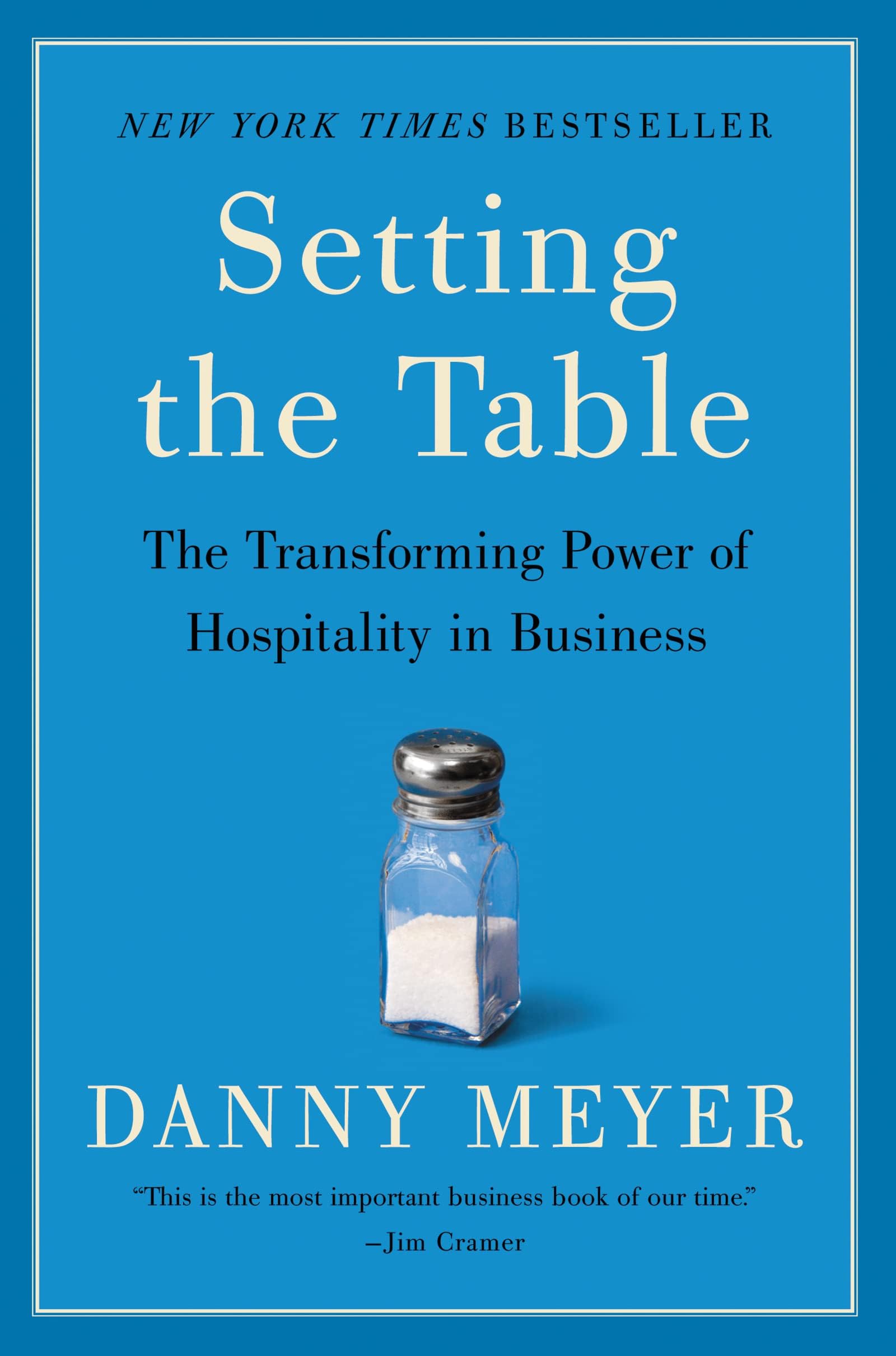
Setting the Table: The Transforming Power of Hospitality in Business
Product ID: 1704986
Buy anything from 5,000+ international stores. One checkout price. No surprise fees. Join 2M+ shoppers on Desertcart.
Desertcart purchases this item on your behalf and handles shipping, customs, and support to Cook Islands.
The bestselling business book from award-winning restauranteur Danny Meyer, of Union Square Cafe, Gramercy Tavern, and Shake Shack Seventy-five percent of all new restaurant ventures fail, and of those that do stick around, only a few become icons. Danny Meyer started Union Square Cafe when he was 27, with a good idea and hopeful investors. He is now the co-owner of a restaurant empire. How did he do it? How did he beat the odds in one of the toughest trades around? In this landmark book, Danny shares the lessons he learned developing the dynamic philosophy he calls Enlightened Hospitality. The tenets of that philosophy, which emphasize strong in-house relationships as well as customer satisfaction, are applicable to anyone who works in any business. Whether you are a manager, an executive, or a waiter, Danny’s story and philosophy will help you become more effective and productive, while deepening your understanding and appreciation of a job well done. Setting the Table is landmark a motivational work from one of our era’s most gifted and insightful business leaders. Review: Here are 10 Valuable Take-Aways from Setting the Table - Setting the Table by Danny Meyer provides lots of value for business leaders. I ranked this book five stars based on the value alone. The reader should be apprised that the book is written as a memoir of Mr. Meyer's experience in the restaurant business. As a business leader you should study excellence in your industry and outside of your industry and there are numerous take-aways in Setting the Table that can be applied to any business. Here are ten excellent points I took away from Mr. Meyer's book. 1. The Excellence Reflex - "A natural reaction to fix something that isn't right, or to improve something that could be better." The excellent reflex is a natural reaction that some people have and cannot be taught. Meyer trains his leaders how hire those that have it. 2. Employees can be categorized as Overwhelmers, Whelmers, and Underwhelmers. It is easy to identify Underwhelmers and get rid of them. The most dangerous employees are the Whelmers because "they infuse an organization and its staff with mediocrity...and send a dangerous message to your staff and guests that "average" is acceptable." 3. Coaching is correcting with dignity. 4. You obtain valuable leadership skills while managing volunteers. It requires you to consistently motivate employees beyond their earnings. 5. Create a sense of "shared ownership" with your customers by taking an interest in them and making them feel important. They will view you as a partner instead of a provider. 6. ABCD - Always Be Collecting Dots. You should aggressively collect lots of little information about your customer (dots) as they interact with your product or service. Then make the connection between the dots as a mechanism to improve your product or service to all customers. 7. Customers may love your product or service but the relationship that they have with you or your employees is what builds loyalty. Therefore you should take every opportunity to exceed expectations to create a lasting relationship. 8. Enlightened Hospitality - "We would define our successes and our failures in terms of the degree to which we had championed, first, one another and then our guests, community, suppliers and investors." This is an extremely powerful concept and is rooted in the integrity theme Meyer has throughout the book. You can't expect employees that don't treat each other with respect, who can't be hospitable with one another to then turn around and treat the customer with respect and high levels of hospitality a customer deserves. Poor relationships internal to the organization migrate to poor relationships external to the organization. Ultimately being last on the list benefits the investor by long term organizational success. 9. Judge your staff on 51 percent emotional job performance and 49 percent technical job performance. You can always teach technical while emotional is much harder if not impossible to develop. Lack of emotional job performance skills destroys teams and alienates customers. 10. "The road to success is paved with mistakes well handled" and "the worst mistake is not to figure out some way to end up in a better place after having made a mistake." The ten points above are obviously more powerful in the context of the book when illustrated with Mr. Meyer's stories and experiences. Dr. James T. Brown PMP PE CSP Author, The Handbook of Program Management Review: Stay for Dessert - As I write this, about 70 or so 5-star reviews have already been written about Danny Meyer's "Setting the Table." Am not surprised. Rather than repeat what's already been said, will just hit some of the highlights and then try to add a few new thoughts. PROS: This book is a gem about managing and growing a business...and not just for folks in the restaurant biz. But it doesn't read like a business book, which is good. Since Meyer is writing about his own experiences, Setting the Table isn't clinical or academic the way many books covering similar themes (how to hire people, the meaning of hospitality, etc.) tend to be. I also appreciated Meyer's ability to learn as much from his mistakes as from successes. Through many examples and stories, he shows how getting better is not only about focusing on what went right but also asking and being honest about what didn't and how it can be improved. Finally, even if you've heard similar insights before, Meyer often puts the pieces together in new & interesting ways, much like the new combos he finds for his theme restaurants. As a result, I came away with more than a few useful applications to my own work, which is in the nonprofit world. CONS: There aren't many cons here. It's just worth noting that the book starts out with about 50 or 60 pages of background on Meyer's formative years, before getting into the restaurant business. Readers who want to get right to the heart of his restaurant career should know this. On the plus side, this is one of those books that gets better as you get deeper into it, so keep going. The dessert doesn't disappoint! BONUS; Though I'm not a restaurant guy or management type, am always impressed by people who can communicate and get messages across to others clearly, in whatever field. Meyer is gifted in doing this. His spot-on explanation of the difference between "hospitality" and "service" is just one wonderful example. As a result, reading the book gave me some good approaches for getting my own ideas across more clearly to others. Not bad for a 10 dollar investment!


| Best Sellers Rank | #5,057 in Books ( See Top 100 in Books ) #2 in Customer Relations (Books) #4 in Hospitality, Travel & Tourism (Books) #99 in Leadership & Motivation |
| Customer Reviews | 4.6 out of 5 stars 3,307 Reviews |
D**N
Here are 10 Valuable Take-Aways from Setting the Table
Setting the Table by Danny Meyer provides lots of value for business leaders. I ranked this book five stars based on the value alone. The reader should be apprised that the book is written as a memoir of Mr. Meyer's experience in the restaurant business. As a business leader you should study excellence in your industry and outside of your industry and there are numerous take-aways in Setting the Table that can be applied to any business. Here are ten excellent points I took away from Mr. Meyer's book. 1. The Excellence Reflex - "A natural reaction to fix something that isn't right, or to improve something that could be better." The excellent reflex is a natural reaction that some people have and cannot be taught. Meyer trains his leaders how hire those that have it. 2. Employees can be categorized as Overwhelmers, Whelmers, and Underwhelmers. It is easy to identify Underwhelmers and get rid of them. The most dangerous employees are the Whelmers because "they infuse an organization and its staff with mediocrity...and send a dangerous message to your staff and guests that "average" is acceptable." 3. Coaching is correcting with dignity. 4. You obtain valuable leadership skills while managing volunteers. It requires you to consistently motivate employees beyond their earnings. 5. Create a sense of "shared ownership" with your customers by taking an interest in them and making them feel important. They will view you as a partner instead of a provider. 6. ABCD - Always Be Collecting Dots. You should aggressively collect lots of little information about your customer (dots) as they interact with your product or service. Then make the connection between the dots as a mechanism to improve your product or service to all customers. 7. Customers may love your product or service but the relationship that they have with you or your employees is what builds loyalty. Therefore you should take every opportunity to exceed expectations to create a lasting relationship. 8. Enlightened Hospitality - "We would define our successes and our failures in terms of the degree to which we had championed, first, one another and then our guests, community, suppliers and investors." This is an extremely powerful concept and is rooted in the integrity theme Meyer has throughout the book. You can't expect employees that don't treat each other with respect, who can't be hospitable with one another to then turn around and treat the customer with respect and high levels of hospitality a customer deserves. Poor relationships internal to the organization migrate to poor relationships external to the organization. Ultimately being last on the list benefits the investor by long term organizational success. 9. Judge your staff on 51 percent emotional job performance and 49 percent technical job performance. You can always teach technical while emotional is much harder if not impossible to develop. Lack of emotional job performance skills destroys teams and alienates customers. 10. "The road to success is paved with mistakes well handled" and "the worst mistake is not to figure out some way to end up in a better place after having made a mistake." The ten points above are obviously more powerful in the context of the book when illustrated with Mr. Meyer's stories and experiences. Dr. James T. Brown PMP PE CSP Author, The Handbook of Program Management
K**R
Stay for Dessert
As I write this, about 70 or so 5-star reviews have already been written about Danny Meyer's "Setting the Table." Am not surprised. Rather than repeat what's already been said, will just hit some of the highlights and then try to add a few new thoughts. PROS: This book is a gem about managing and growing a business...and not just for folks in the restaurant biz. But it doesn't read like a business book, which is good. Since Meyer is writing about his own experiences, Setting the Table isn't clinical or academic the way many books covering similar themes (how to hire people, the meaning of hospitality, etc.) tend to be. I also appreciated Meyer's ability to learn as much from his mistakes as from successes. Through many examples and stories, he shows how getting better is not only about focusing on what went right but also asking and being honest about what didn't and how it can be improved. Finally, even if you've heard similar insights before, Meyer often puts the pieces together in new & interesting ways, much like the new combos he finds for his theme restaurants. As a result, I came away with more than a few useful applications to my own work, which is in the nonprofit world. CONS: There aren't many cons here. It's just worth noting that the book starts out with about 50 or 60 pages of background on Meyer's formative years, before getting into the restaurant business. Readers who want to get right to the heart of his restaurant career should know this. On the plus side, this is one of those books that gets better as you get deeper into it, so keep going. The dessert doesn't disappoint! BONUS; Though I'm not a restaurant guy or management type, am always impressed by people who can communicate and get messages across to others clearly, in whatever field. Meyer is gifted in doing this. His spot-on explanation of the difference between "hospitality" and "service" is just one wonderful example. As a result, reading the book gave me some good approaches for getting my own ideas across more clearly to others. Not bad for a 10 dollar investment!
L**N
Vision and Execution
Danny Meyer recounts his journey to become a leading restauranteur in NYC and, with ShakeShack, beyond. The book tells about his initial passion, influences, lessons learned, and wisdom gained. His restaurants are special because they are unique and incorporate, unlike many new “concept” restaurants today. The book was written before Covid, so does not discuss the challenged of that time. But he has a new book about to be released and I look forward to reading how he has managed through challenging times.
N**D
How Union Square Hospitality Group revolutionized the hospitality business
Important disclaimer: I'm a fanatic for the restaurants of Union Square Hospitality Group — Danny Meyer's warmly hospitable restaurant group in New York City, and I dine at the group's venues like Union Square Cafe, Gramercy Tavern, the Modern, and Ci Siamo on a regular basis. Yes, the chefs at all four of these particular restaurants are masters, producing seasonal menus with unique personal touches. Yes, I would not visit these restaurants as often if the food and beverage selection weren't as excellent as they are. But, these restaurants have also perfected hospitality, and the book "Setting the Table" is the story of how that happened. Meyer frames his business model in deep personal stories of early family travels and his own trial by fire investment and experimentation throughout out his business career. At the core of it all: hospitality begins with how a business treats its employees—a priority I have made my own, in my own non-hospitality related management to grateful success. The stories ramble a little, but are evocative. If you're looking primarily for a business textbook, you'll need to prepare yourself for a warm, personable journey that fits the book's theme. But between and within the stories you will be treated to the solid business advice you will want from the master of hospitality himself.
F**N
Not Just for Foodies
A friend of mine turned me on to this wonderful business book by James Beard award-winning Restaurateur Danny Meyer (of Union Square Cafe, Blue Smoke, Gramercy Tavern, Eleven Madison Park, Tabla, Shake Shack, The Modern, and Hudson Yards Catering fame). My friend had mentioned to me that this was a book that his boss (an accomplished businessman and investor who I greatly admire) couldn't stop talking about. It wasn't far into this book that I too could see the reason behind the enthusiasm of my friend's boss. This is not a book for only foodies, restaurant owners, and food writers. It is a book for all people that are serious about business, leadership, and management. Danny Meyer is a lucid thinker, whose business philosophies (of "enlightened hospitality") are proven, distilled, powerful, and timeless. Frankly, reading this book has heightened my antenna to businesses that get customer service right, and unfortunately to the large majority that get it painfully wrong. Whether it is teaching his people to be agents not gatekeepers, developing a new restaurant's real estate assets based on the concept of "context, context, context" instead of "location, location, location," making customers feel like the have a shared ownership, by hiring "51 percenters", collecting and connecting dots, expanding his business empire in a concerted way that doesn't overextend the business's resources- Danny Meyer demonstrates his prowess as not only a Restaurateur, but also an entrepreneur, writer, leader, manager, and visionary. The Kindle addition of this book does suffer from sloppy editing, which is ironic given the meticulous nature of Meyer when it comes to his restaurant empire. For example, the temperature feels like "twenty five degress", service is "ser vice"; Meyer was "champing" not chomping at the bit, etc. These editorial oversights have the taste of a lamb chop cooked dry and served cold in an otherwise brilliant restaurant. Despite these minor editorial shortcomings, Meyer in "Setting the Table" has written a lasting business book for not just food people. This is an important and well-written book that outlines an enlightened, customer-centric, at times counter-intuitive, but consistently effective approach to not only business, but also life.
T**I
Spot on
Danny Meyer lays out some knowledge, wisdom, and business philosophy in this book that is invaluable. Like Danny, much of what I have learned in the Food & Beverage Industry over the years has led me to intuitively come to certain conclusions about how things are to be done. I was really taken aback when I saw many of the same principles on paper in front of me, put there by a hugely successful man in the business. I was beginning to feel like I was alone, or at least a very rare breed, in thinking this way. I've been stuck in a very unprofessional area for the last 6 years and have been trying my best to uphold what I believe are the values in doing business the right way. I have met with much opposition by the ownership in many places here who do not have a background in the business and who see things differently. This has led to a plethora of mediocre establishments and many who can't even be called that. Many are now closed and just get gobbled up by the crappy chains that abound here. I wish every person who owns or plans on opening a restaurant would read this and take it to heart. You may not agree with 100% of it. I know I didn't. But I could not find fault with hardly any of it. Danny is a guy who has heart and soul. He is a shining example of somebody in it for all the right reasons.
D**.
Needs Update/Reader Left With Uncomfortable Questions
I have two challenges with this book. First, Danny Meyer's autobiography on using "enlightened hospitality" to create successful restaurants in New York was publsihed in 2006. I purchased my copy in January 2013. Between 2006 and 2013, Mr. Meyer and his Union Square Hospitality Group (USHG) closed at least one restaurant and sold another. In 2006, Mr. Meyer asserted in his book that he had not had to do either. Much has obviously happened in the last seven years to the USHG and Mr. Meyer's restaurant choices. I believe he has also opened more places. The book needs a thorough updating where Mr. Meyer discusses the changes in the USHG and how these changes may have affected/cemented his belief in enlightened hospitality. And the last chapter is now out of date. Second, Mr. Meyer made a convincing argument in the first two-thirds of his book that enlightened hospitality (EH) is critical to his vision of a succesful restaurant business. However, I realized almost at the end of my read, that the vast majority of Mr. Meyer's examples of EH are about his restaurant patrons. On page 240, we finally get to a discussion about USHG's employees. Mr. Meyer says that his emplyees are first in his "Virtuous Cycle of Enlightened Hospitality," yet he spends only three pages talking about what he does to show them EH. Honestly, I was not convinced by his three-page discussion that he shows concrete EH to his employees. He says he has created a workplace where the staff are respected and show respect to each other. That is really nice but not enough if you can't meet your personal bills. He says it is important to him "that our wage scales be competitive with those of other restaurants." Why is that acceptable? He has hired the nicest, best, most skilled staff in NY, Why doesn't he pay his employees above the average wage scale? He also says he pays for medical and dental for his full-time employees. That begs the question -- how many employees are full-time and how many part-time? And will his ability to pay for employee insurance change with the implementation of the Affordable Health Care Act? I absolutley admire Mr. Meyer's vision of enlightened hospitality. And I want to believe that he shows it to his 1500+ staff. I just wish "Setting the Table" had shown more evidence of this. I will be thrilled to give my review more stars if I can find consistent, continual examples of EH shown to Mr. Meyer's employees. I also hope Mr. Meyer revises and updates "Setting the Table" so that we can see how he has applied enlightened hospitality to the changes at the USHG during the last seven years.
J**S
Exceptional Story Telling & Simply Best at Running a Business
Danny Meyer tells his story exceptionally well and runs his business the way the best of the best tell you to do it-execute your vision, pay attention to your customer and pay attention to detail. This is an autobiography in which the lessons of life and business cannot be separated. Having dined at Union Square Cafe(food was great) and 11 Madison Park(this was an incredible experience) I demanded that my kids get me this book for Christmas. The fact that it is a quick read is due to the absorbing content not the size. What a treat to read how he took a childhood vision and gradually turned it into a multi-faceted company with more than 1,000 people without losing touch with his roots. His attention to his staffs' needs and his customers' needs, his listening skills and the means with which he elicits feedback, responds to and solves problems as a means of self-improvement reflect his sense of fun. Danny Meyer shows that his greatest guide was his ability to learn from people around him and his desire to delight customers with something unique and special. Any CEO will learn volumes from reading this book regardless of the business.
A**A
Best book
Very good read
K**Y
Good book
Fast delivery and a book worth reading.
A**S
Biografia di un noto impenditore di successo
Parla della vita del Sig. Mayer partendo dalla sua infanzia alla scalata di successo come imprenditore nel settore della ristorazione di alto livello. Lettura piacevole ed interessante dove si possono prendere molti spunti e riadattare alla propria situazione. Consiglio vivamente l'acquisto.
M**A
Important lecture
Super super !!!!
G**Y
muy interesante
Me gustó que te cuenta su vida, antecedentes, historia y los aprendizajes de sus experiencias. Está entretenido al mismo tiempo que vas aprendiendo.
Trustpilot
1 month ago
3 weeks ago